My first few weeks here at the Lincoln Boyhood National Memorial have gone well, and I’m settling in quickly. I am finding that this place already feels like a new home to me. In the time I’ve spent here, I have already made many memories I know I’ll carry with me forever!
The Lincoln Boyhood National Memorial is primarily centered around the location’s history, as one would expect. Even though my interests and project are mainly concerned with the natural world and its relationship with current and future human activity in the park, I’m very much enjoying learning more about the historical context behind the area.
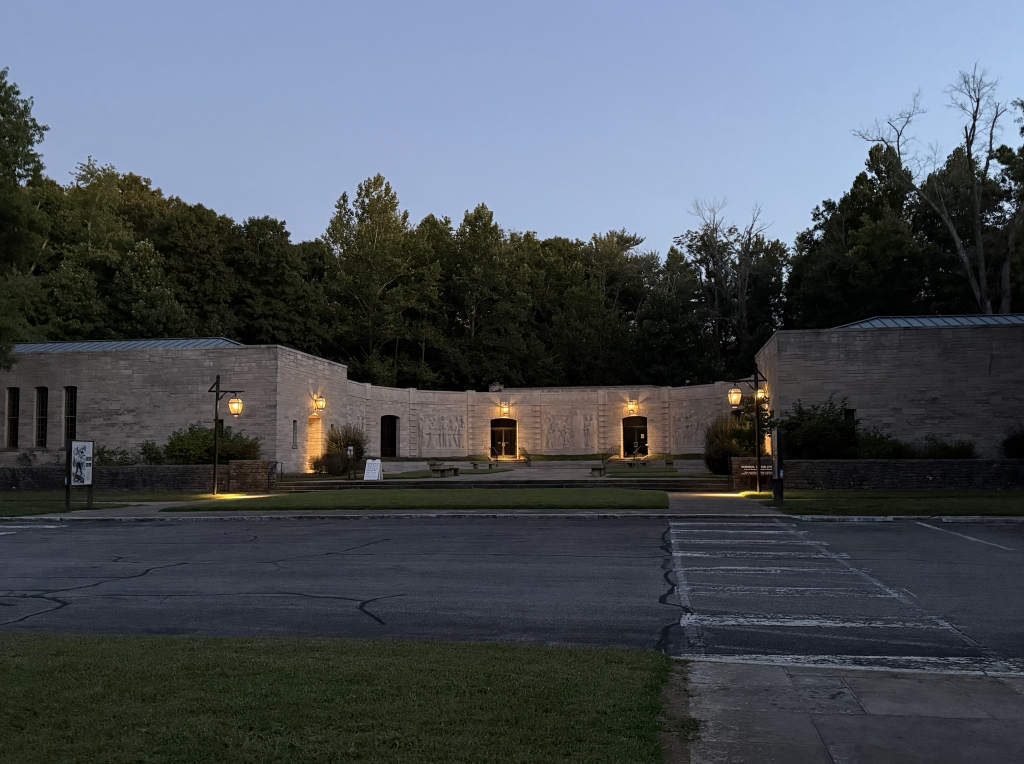
The site is made up of just a few buildings that are open to the public – the visitor’s center, with its grand stone carvings illustrating important points in the life of Abraham Lincoln, and the farm and cabin recreation. The cabin is unfortunately not in the precise location where the Lincolns lived, and isn’t made with any of the original materials as precious little was left behind to salvage during the attempted restoration of the site. However, it represents what a typical cabin might have looked like, as is the small farm also intended to actualize what is known about pioneer farming during the early 1800s.
Near the visitor’s center is the pioneer cemetery, which is where Abraham Lincoln’s mother and several other members of the Little Pigeon Creek community were laid to rest during its early settlement. Like the cabin site, the precise location of Nancy Hanks Lincoln’s gravesite is not known – instead, her headstone (added many years later) and those of her friends and family were positioned based on investigations of where the ground had been physically disturbed and what historical information remained. It is very impressive to me that we are capable of finding burial sites that are over 200 years old with our current technology! Again, while history and archaeology aren’t my main interests, I have still always greatly enjoyed these subjects. In college, I dabbled in more theoretical archaeology, and have found myself thinking back to and applying a lot of the concepts and ideas I learned from those classes to this site.
For example, in the time since taking a few archaeology classes, I have come to feel very differently about archeological/historical sites. It is a strange, but very profound, experience to stand in a site or handle an artifact that someone many years ago once did in the exact same way. It creates a feeling of connection between oneself in that moment and the very same moment a person in the past experienced. Alongside my work with the natural sciences, I hope to keep finding other aspects of interest to consider as I become more familiar with the park!


No Comments